
Avoid Costly Mistakes Before Fabrication Begins
Before any tank project enters production, the manufacturing team shares an “Approval Drawing” with the customer.
These drawings aren’t just engineering paperwork–they’re your chance to make sure the tank manufacturer is building the vessel to your expectations. By taking the time to carefully review the drawings, you can help prevent production delays, change orders, installation headaches and expensive field modifications.
Once fabrication begins, changes are more difficult and costly.
Let’s take a look at how you can read an approval drawing and get your tank project kicked off right.
What is an Approval Drawing?
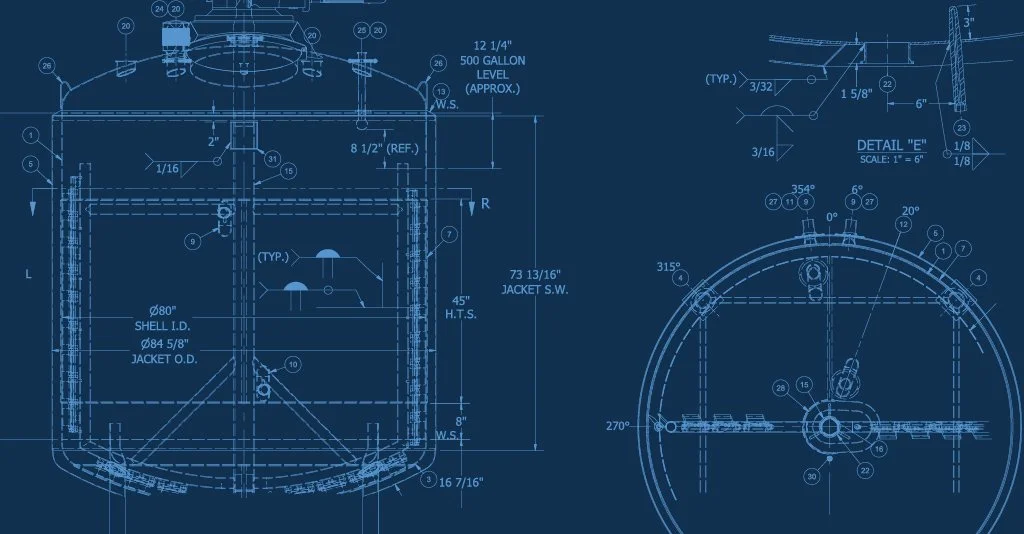
Approval drawings are detailed blueprints created after the order is placed. They are the manufacturer’s way to translate the written specifications into a visual representation of the project. In addition, the drawing includes the features customers don’t focus on, such as internal supports.
A typical tank project approval drawing will include:
Dimensions
Nozzle sizes & locations
Tank orientation & elevation views
Material & finish details
Agitator details & location
Motor details
Code information
It might seem like a firehose of information, but a good manufacturer lays the approval drawing out in an easy-to-understand format.
How the Approval Process Works
Every tank manufacturer has their own approval process, but they follow a similar path.
It starts when the customer requests a quote. The sales team takes the customer’s request and develops a quote based on their specifications. Once approved by the customer, the engineering team creates the approval drawing, which is shared as a PDF
The customer then reviews the drawing and either requests changes or approves it as is. If they require changes, the engineering team will update the drawing accordingly and send it back to the customer for another review. This process is repeated until the drawing s approved, at which point fabrication begins.
Watson Custom Tanks provides customers 5 business days to review and approve drawings.
What Happens When You Request Corrections
Customers have three options upon reviewing a drawing:
Approve the drawing without changes – This means the project is ready to move forward without delay.
Approve the drawing with changes – If only minor adjustments are needed, the customer can mark the drawing as “Approved As Noted.” The engineering team will make the changes to the blueprint and move the project onto fabrication without sending a new drawing for approval.
Request changes & new approval drawing – When major changes are needed, the customer can request a new approval drawing to double-check changes.
Most projects are approved within two rounds of approval drawings.
What Customers Most Often Miss
Approval drawings provide all the information about the tank project. Customers must review everything from the material type to nozzle locations.
With all that information, it’s no surprise that customers sometimes overlook certain pieces. Here are some of the most commonly missed details:
Overall Dimensions – Watson receives several requests every year to shorten tanks because customers run into clearance issues after receiving their tanks. Customers need to consider the overall dimensions of the tank in the context of their facility. It’s easy to look at a drawing and think, “Those specs will fit my needs,” without considering how the vessel will fit into their existing footprint.
Key Considerations
Height
Ceiling clearance
Installation space
Nozzle Locations – Every nozzle will connect to something later, and if they’re cut in the wrong locations, it can cause issues during installation and startup. The approval drawing shows exactly where each nozzle will be oriented on the tank.
Key Considerations
Quantity
Location & orientation
Size
Type
Material Finish – Different products require different material finishes for proper sanitation and flow. Customers should always make sure the material finish indicated on the approval drawing match their needs.
Key Considerations
Interior finish
Exterior finish
Chemical compatibility
Materials – Certain chemicals and food product require specific materials. Customers should always make sure the correct material is denoted on the approval drawing.
Key Considerations
304 vs. 316 stainless steel
Gasket & seal materials
Agitator - The agitator is key to ensuring product is properly worked during the process. Customers should make sure the agitator in the drawing fits their particular needs.
Key Considerations
Viscosity needs
Motor sizing
Gearbox
Mixing requirements
Orientation – The approval drawing shows the elevation and orientation of the tank. Elevation refers to the vessel’s height and orientation shows the rotational positioning in degrees. Customers often confuse the two, creating confusion about nozzle locations and more.
Other Information – It’s easy to get caught up looking at the drawing and overlook the information block. This section contains details about everything from where the tank will be deployed to the codes and standards it’s built to.
Key Considerations
Codes & ratings
Seismic information
Delivery location
How to Request Changes
Avoid providing changes verbally or over a chain of emails. The manufacturer’s engineering team is likely working on multiple projects at once. Verbal changes are hard to track and ensure they’re translated into the new tank. With multiple emails, the customer risks one or more emails getting “lost” and those changes not being addressed.
The best solution is to send all changes in one email. The customer can mark up and redline the drawing and send that back to the manufacturer. Or, type out every change in bullet form and email that to the manufacturer. Both ensure your changes are in one place and easy to understand.
How Much Do Changes Cost?
The approval drawing provides customers the opportunity to make changes to the project without incurring extra charges or delaying the project. That said, it’s not meant to be a free-for-all. Most manufacturers give customers a set number of approval drawings before charging for changes.
In addition, changes like minor fitting relocations typically won’t increase project costs or lead times. But, adding nozzles, replacing materials and any other changes to the project scope may incur charges and/or affect the tank fabrication schedule.
Customers can reach out to the tank manufacturer for more exact information about how minor and major changes can affect the project dates and budget.
Approval drawings define the final product, but they’re not the final drawings. Manufacturers like Watson Custom Tanks keep the revision history just in case, as well as a final drawing that includes all the requested changes. Years down the road, the field service team will refer to the final drawing for repairs and maintenance.
To ensure your tank project moves forward on time and on budget, carefully review the approval drawing for your project. Don’t just glance at the illustration; read through the dimensions, fittings, notes and specifications. Remember, it’s much easier and cheaper to change the tank when it’s just a drawing than when it’s in fabrication or in your facility.
If in doubt, ask questions–that’s what the approval process is for.